12,497 Knots
embroidery directly on photographic print
Tehran, 2013–2026
Mahan Abasian & Pardis Hesami
This series begins with a simple disruption: something is sewn onto the surface of an image, so that the eye can no longer pass through it in its usual way.
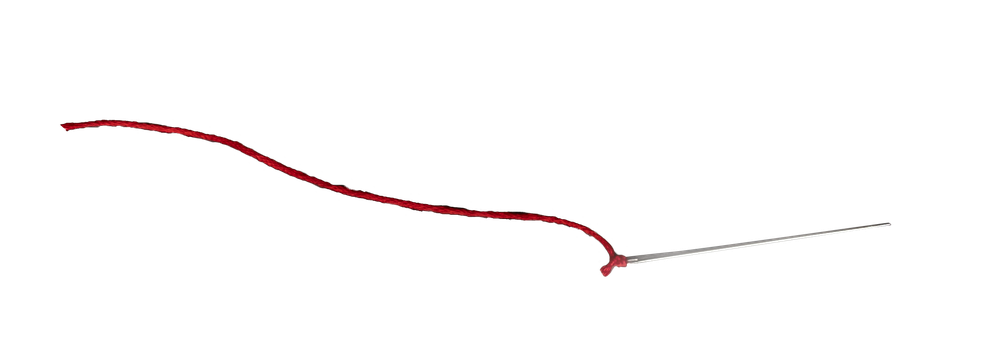
Thread here is not decoration — it is intervention. The stitches are a means of touching what has remained beneath the surface. The distance between the shutter and the needle is sometimes years. This gap is not accidental; time itself is part of the work.
A knot is a pause: it's a small pressure on our visual habits — not to break them, but to make them visible.
12,497 KNOTS. One city, Tehran — still unseen.
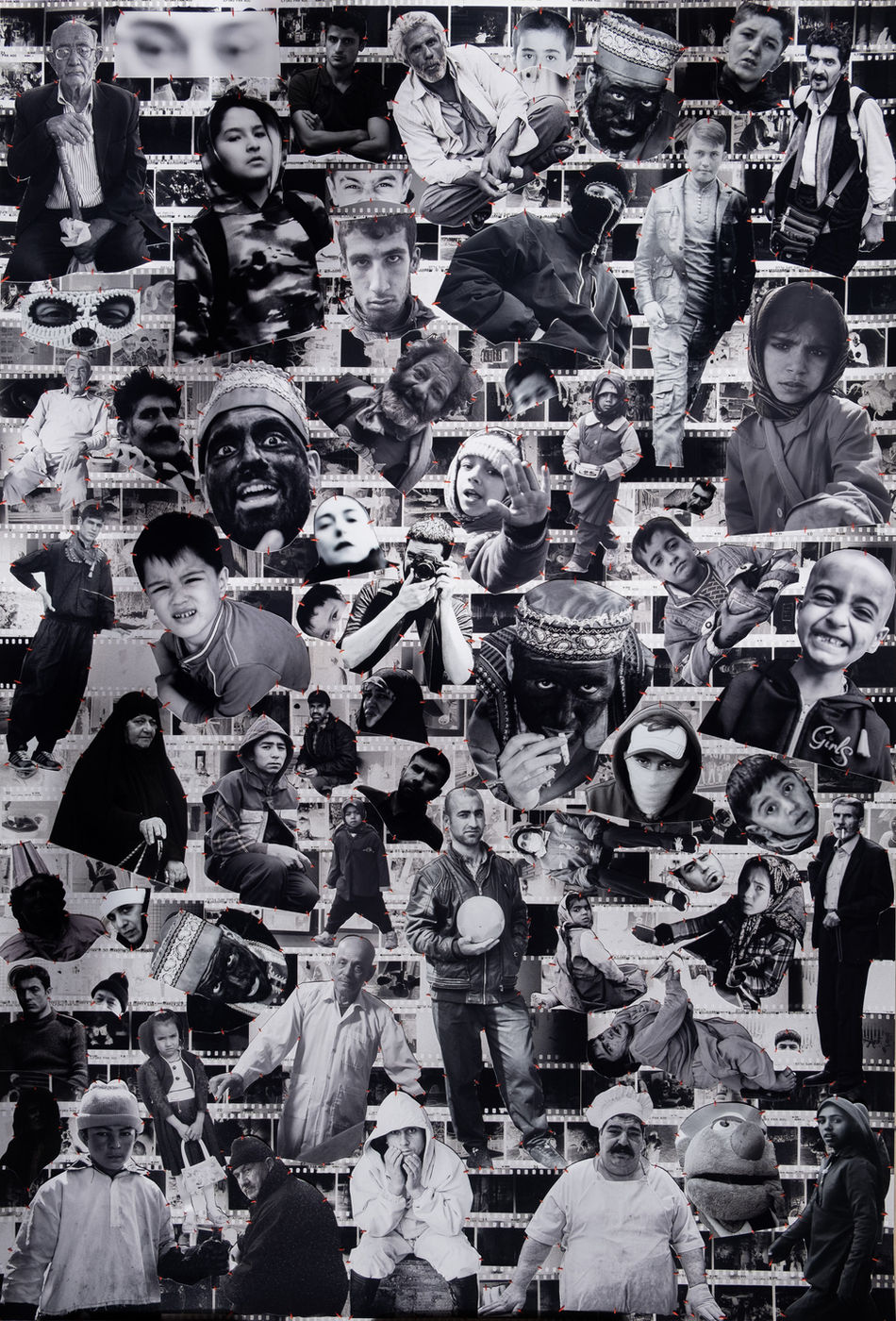
Since 2013, we have been photographing these faces. Across more than a decade, they have appeared before different cameras, different formats, and different versions of the city: 35mm film, 120 film, and digital photography. The technology changed. The city changed. We changed. But they continued to look back.
They are not simply the people we photographed. They are witnesses. Each face carries a fragment of Tehran within it—not necessarily as a recognizable landmark or a documented event, but as something more elusive: the atmosphere of a particular time, the weight of a particular day, the way a person inhabits the city and is, in turn, shaped by it. To look at them is to be looked at.
For more than thirteen years, these people have stood on the other side of our cameras, silently returning our gaze. Through them, we have watched Tehran change. And perhaps, without realizing it, they have watched us change with it.
The photographs were made through different technologies, but their differences are deliberately brought together here. Film carries its grain and physical trace. Digital carries another kind of precision. The 35mm and 120mm negatives preserve the material evidence of the moments from which these images emerged. And on the reverse side of the work, those negatives return.
The image faces us from the front; its original trace faces us from behind. The photograph therefore becomes more than a surface. It becomes an object with memory on both sides. These are the witnesses of Tehran. They witnessed the city. We witnessed them.
And for thirteen years, through every frame, every roll, every sensor, and every return to the same streets, something has been watching us all along.
Perhaps that is what a photograph ultimately does:
It does not only preserve what we saw. It preserves the fact that we were there to see it.
Before entering these photographs, we would like to offer a small note about the texts that accompany them.
As Iranian artists working with images deeply rooted in the streets, memories, symbols, and cultural realities of Tehran, we are aware that some of what exists naturally within these photographs may not be immediately visible to a viewer unfamiliar with Iran.
For this reason, we have chosen to accompany each photograph with a short text. These writings are not intended to explain the photographs completely, nor to tell the viewer what to think or how to see them. Rather, they are an attempt to open a door—to provide a little context where cultural distance might otherwise create silence.
Some gestures, symbols, words, historical references, and everyday experiences carry meanings that may be immediately understood by someone who has lived within this culture, but remain invisible to someone looking from elsewhere.
We therefore write not to close the images, but to make their doors slightly easier to find.
The photographs remain open. The embroidery remains open. And the stories we have written are only one possible path into them.
This distance between cultures is also part of what makes this exhibition meaningful to us. It allows these images, born from a very specific place, to begin a conversation beyond it.
We are deeply grateful to Decagon Gallery for giving us the opportunity to bring this body of work into an international context, and for creating a space where these photographs can be encountered by viewers far beyond the streets in which they were made.
Thank you for looking.
And, most importantly, thank you for staying long enough to look again.
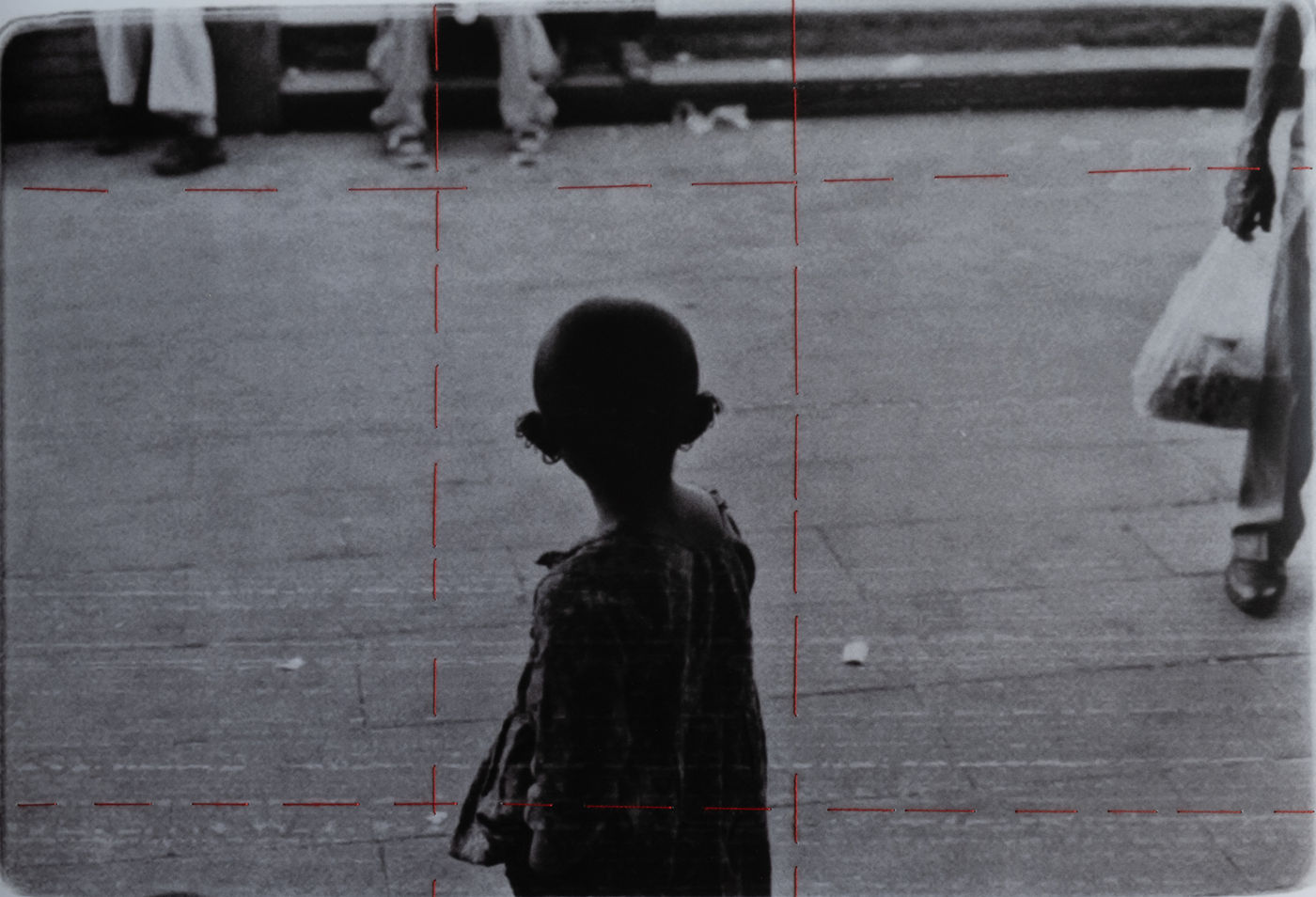
The original negative of this photograph is lost. What remains is not the negative itself, but a photograph of the negative—an image accidentally captured with a mobile phone while searching through the archive. We looked for the original for a long time, hoping to recover it and return the photograph to its proper resolution. We never found it. At first, this felt like a loss. Then we began to wonder if the photograph had already found its final form. The image we are looking at is therefore several steps removed from the moment it was made. Reality became a negative; the negative became a photograph; the photograph became a phone image; and that fragile reproduction became the work you see here. Its imperfection is no longer a technical problem. It is evidence. The frame carries this history within itself. The composition appears almost suspended, as if the image is struggling to remain present while the physical object that once contained it has disappeared. What should have been the most reliable proof of the past—the original negative—is precisely what is missing. And yet, the past has not disappeared. It has changed its material. Perhaps memory works in much the same way. We lose the object, the place, the body, the exactness of the moment. What remains is never identical to what was there. It is altered, degraded, fragmented—and still unmistakably present. Earring is therefore less a photograph than a proposition: Can something be lost if its image survives? We believe the answer is no. The negative is gone. The image remains. And somewhere between the two, the past continues to look back at us.
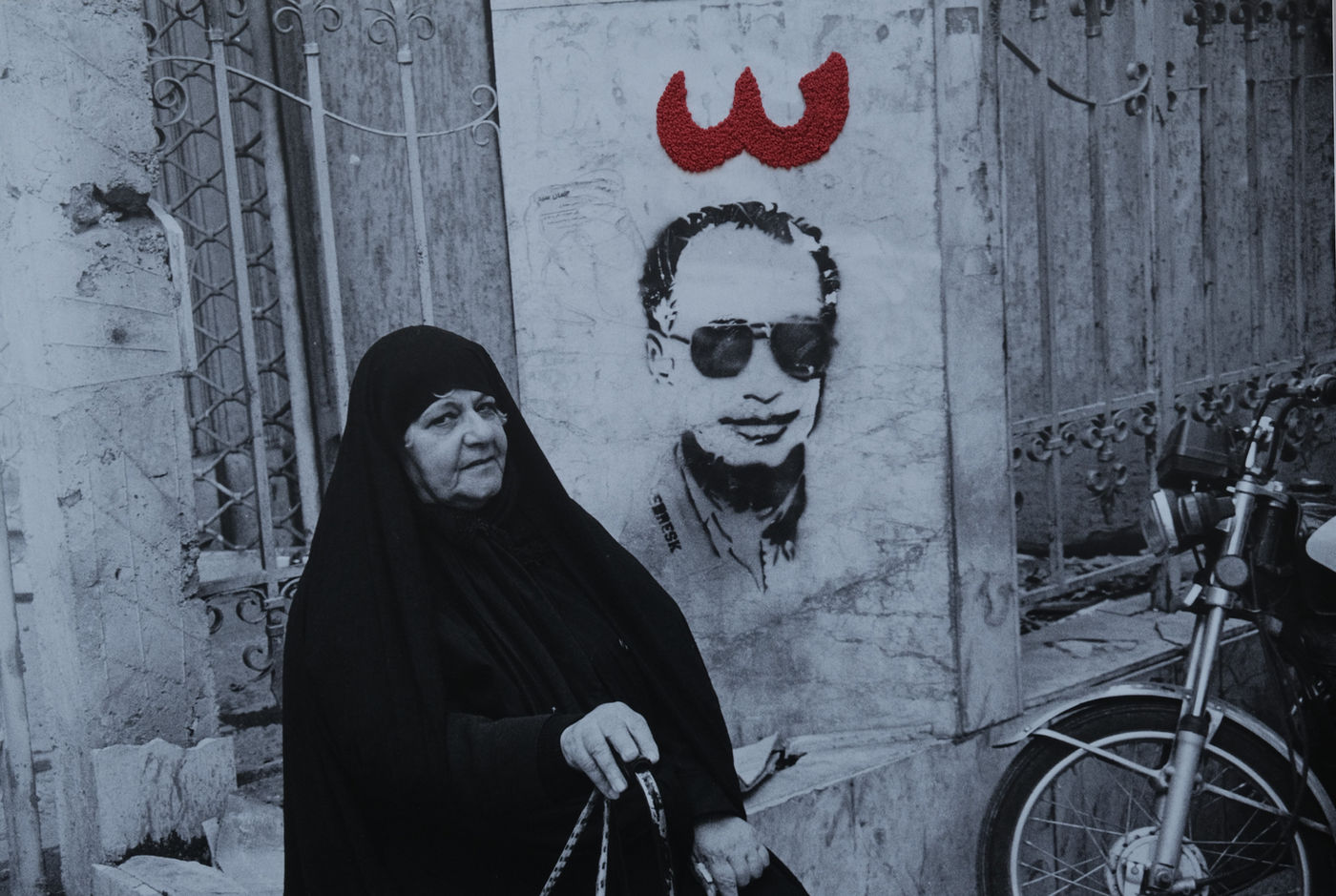
Abbas Kiarostami stands at the centre of this image—not only as one of the most influential Iranian filmmakers, but as an artist who taught us to look differently at what is already in front of us. Born in Tehran in 1940, Kiarostami worked across cinema, photography, poetry, and visual art. His films often appeared deceptively simple, yet beneath their quiet surfaces they created spaces for uncertainty, participation, and reflection. He once described his approach to cinema through a simple principle: “A film is a question.” He believed that the empty spaces left within an image were not deficiencies, but invitations for the viewer to complete the work in their own way. This photograph places his image within the everyday surface of Tehran, beside a piece of graffiti. Above his head, we have embroidered the tashdid. In Persian writing, tashdid is a diacritical mark placed above a consonant to indicate that the sound is doubled or repeated. A small sign, almost invisible, whose entire function is repetition. Here, repetition becomes a gesture of inheritance. We return the tashdid to Kiarostami—not as an attempt to reproduce his work, but as a wish to repeat his way of looking. To look again. To leave something unresolved. To trust the viewer. To find poetry inside the ordinary and allow the frame to remain larger than the story it contains. Kiarostami once said that he believed the viewer should not complete a film in exactly the same way as everyone else; the blank spaces should remain open for each person to fill according to their own thoughts and desires. Perhaps this is what we hope to inherit from him. Not a style. Not an image. A way of looking. The tashdid is repetition, but repetition is never quite identical. Each return changes what came before it. So we stitch the mark above his head like a small promise: We will look again. We will return to the image. We will try to continue the path. And perhaps, in repeating the gesture of looking, we may find our own way forward.
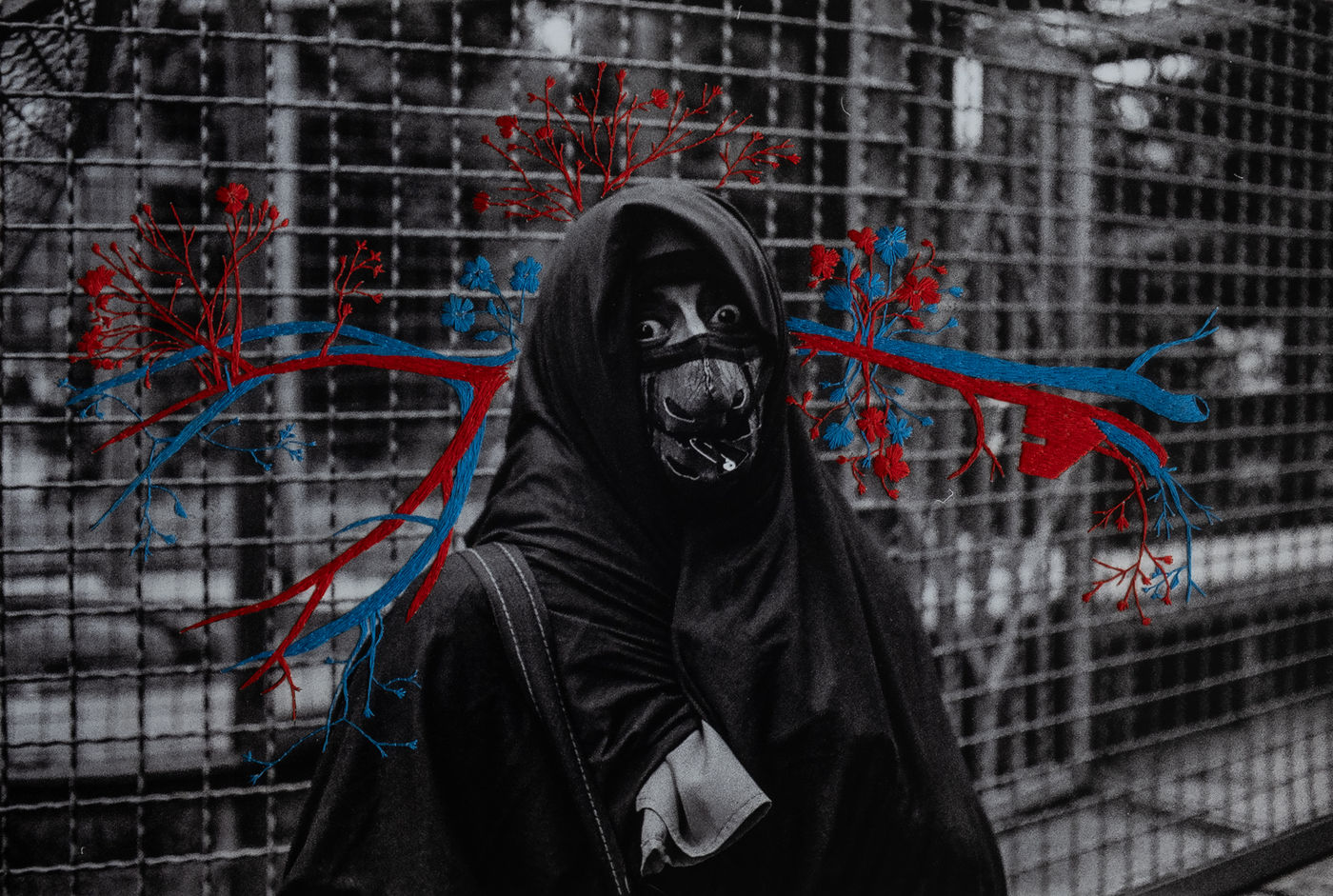
The Master is gone. What remains is a generation standing before an absence it never chose, trying to find its way without the figure who once stood ahead of it. This portrait is not simply about the disappearance of a person. It is about the disappearance of a position: the one who knew the path, the one who had already walked far enough to leave something behind for those who would follow. He seems to have inherited a world without inheriting the map by which to navigate it. A generation without a Master must begin again. It must make its own mistakes, discover its own wounds, and experience for itself what could once have been learned through another’s experience. It cannot simply place its feet upon the shoulders of those who came before and see farther from that higher ground. The accumulated height of experience is lost when no one remains to carry it forward. And in the absence of direction, something begins to change. He is not simply lost. He is becoming transformed by the absence itself—slowly alienated from his own sense of direction, suspended between what he was taught and what he has yet to discover. The embroidery traces this condition across his body. Each stitch becomes a mark of a transformation that cannot be seen from the outside: the gradual process of becoming unfamiliar to oneself. The Master is gone. The path is gone with him. And a generation, deprived of the possibility of following, is left to invent a direction of its own—while risking, in the process, becoming something it never intended to be. They are not without movement. They are without direction.
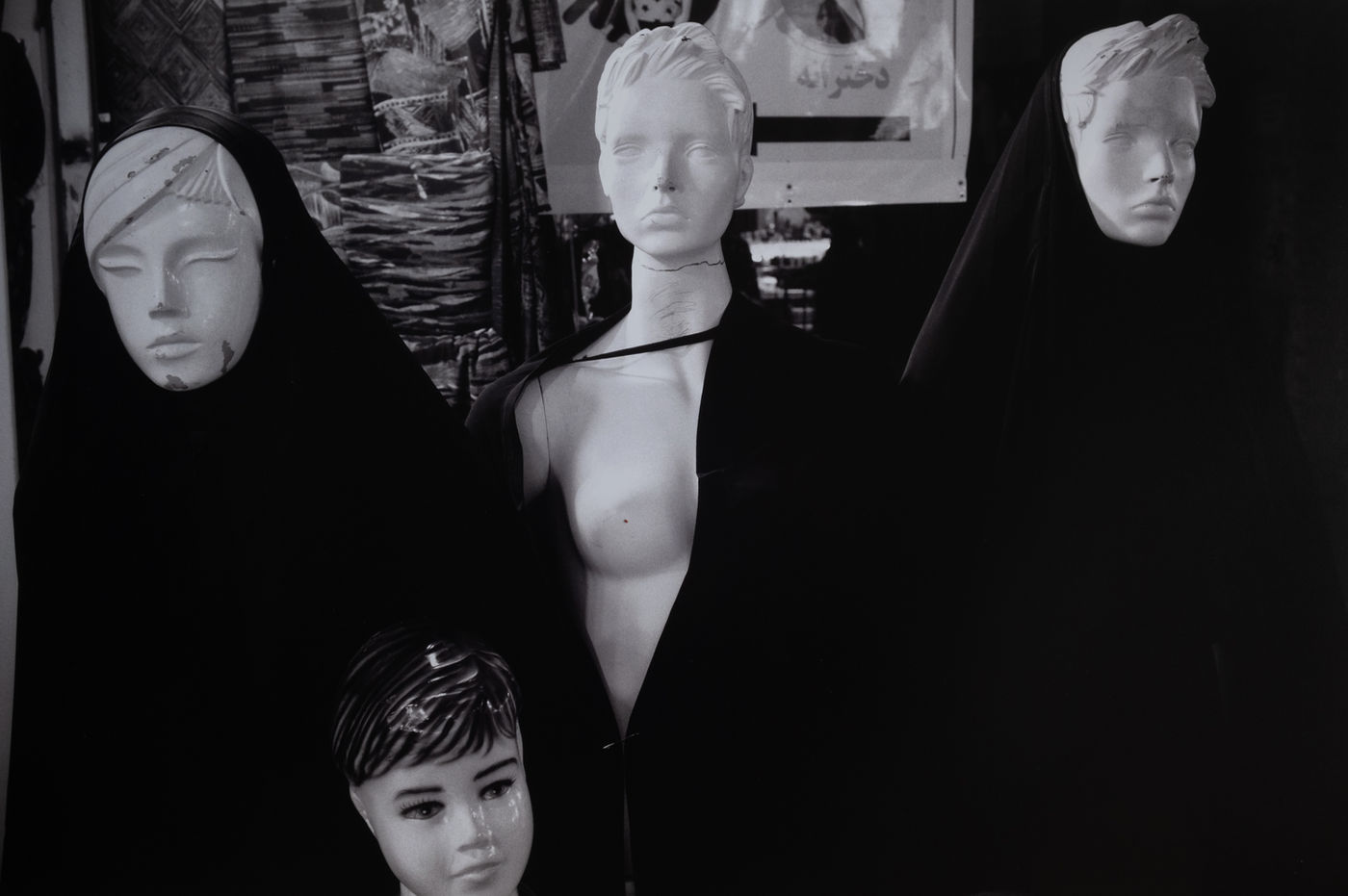
In Tehran, even the bodies that do not breathe are expected to obey. In public space, the hijab is not simply a personal choice of clothing. It is also part of a system of social and legal expectations governing how women’s bodies may appear in public. These expectations extend beyond the living body: in Iran, shop owners are also expected to observe rules concerning the clothing of mannequins displayed in storefronts. And so, even here, behind the glass of a shop window, the mannequin is covered. A body without a body. A woman without a woman. A representation that must still follow the rules of representation. This is where Public Body begins. We were interested in this strange transformation: how the female body, even when absent, imagined, artificial, or entirely made of plastic, can remain subject to the same visual regulations imposed upon a living woman. The mannequin stands in public, but its body is not entirely public. Its visibility is negotiated before it can even be seen. Against this controlled surface, we made only one intervention: a single purple stitch, placed at the position of the woman’s breast. One stitch. Nothing more. We did not cover the body. We did not uncover it. We simply marked the place where the body has become most heavily charged with meaning. The stitch is small enough to be almost overlooked, yet it quietly insists on the existence of the body beneath the rules imposed upon its image. Perhaps this is the paradox of the public body: the more carefully a body is regulated, the more visible the question of the body becomes. Here, even absence has to dress properly. Even a mannequin has to comply. And one small purple stitch asks what remains of a body when the public is allowed to see everything except itself.
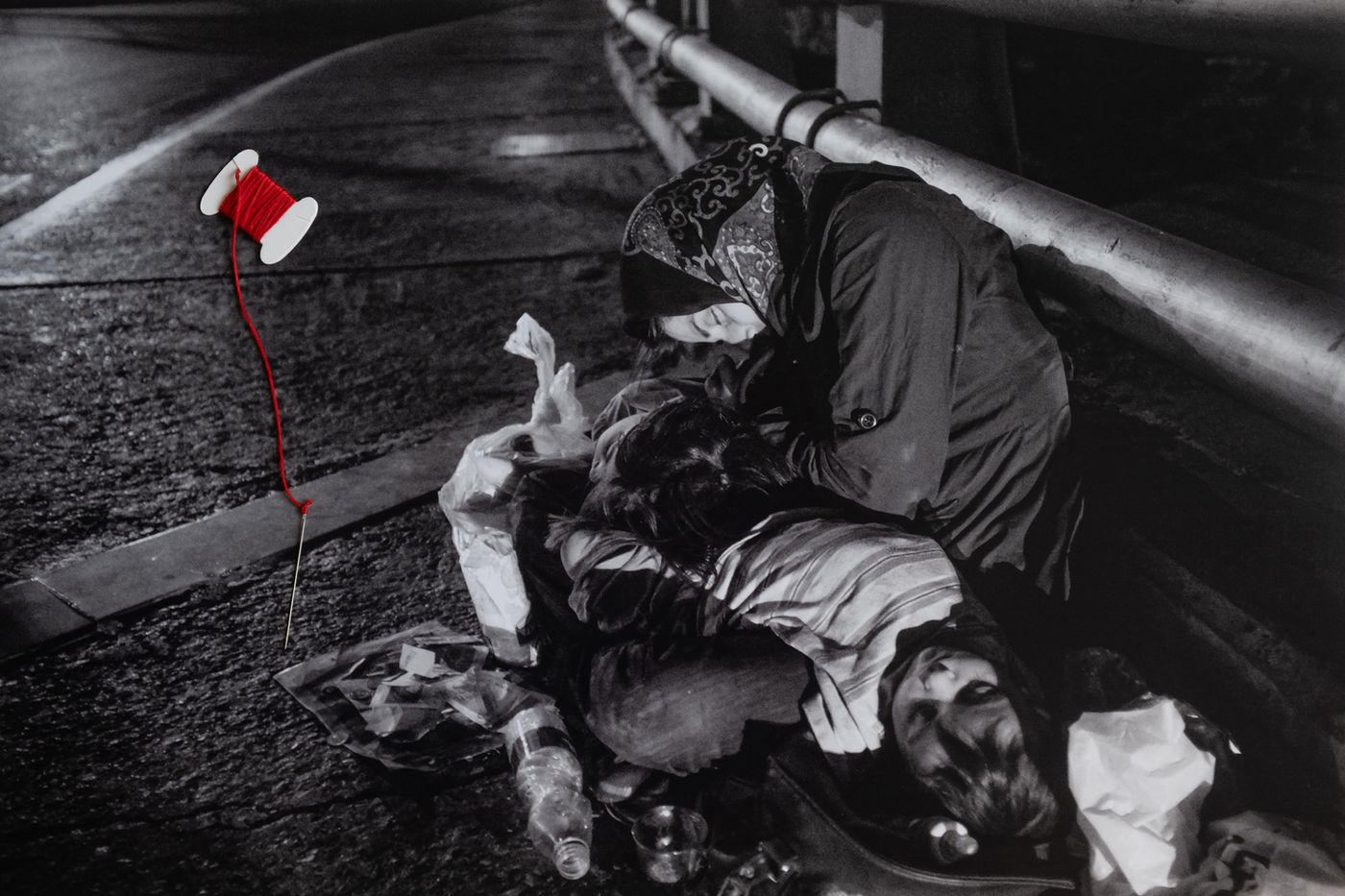
A mother and two children sleep beside a roadside. We embroidered this photograph again and again. Each time, we believed we had found the missing gesture, the missing thread, the thing that would finally allow the image to arrive somewhere. But every attempt left us with the same feeling: something was still missing. So, in the end, we decided not to finish it. Instead, we left the needle hanging. A spool of red thread descends from the photograph, suspended in front of the image like a quiet interruption. It is the tool of intervention, deliberately placed outside the frame. The photograph remains open, unfinished, waiting for another hand. The title is an invitation. Not an instruction, and not an answer. Your Turn. What would you sew? Would you cover the road? Stitch the sleeping bodies together? Draw a boundary around the mother and her children? Repair something that appears broken? Or perhaps leave the photograph exactly as it is? The red thread has already crossed the distance between the image and the viewer. What happens next belongs to you. For us, this photograph could never be completed. Perhaps because some images resist being resolved. Perhaps because looking is never neutral: every gaze adds something, removes something, or leaves something behind. So we offer you the needle. The frame is open. The thread is waiting. Your turn.
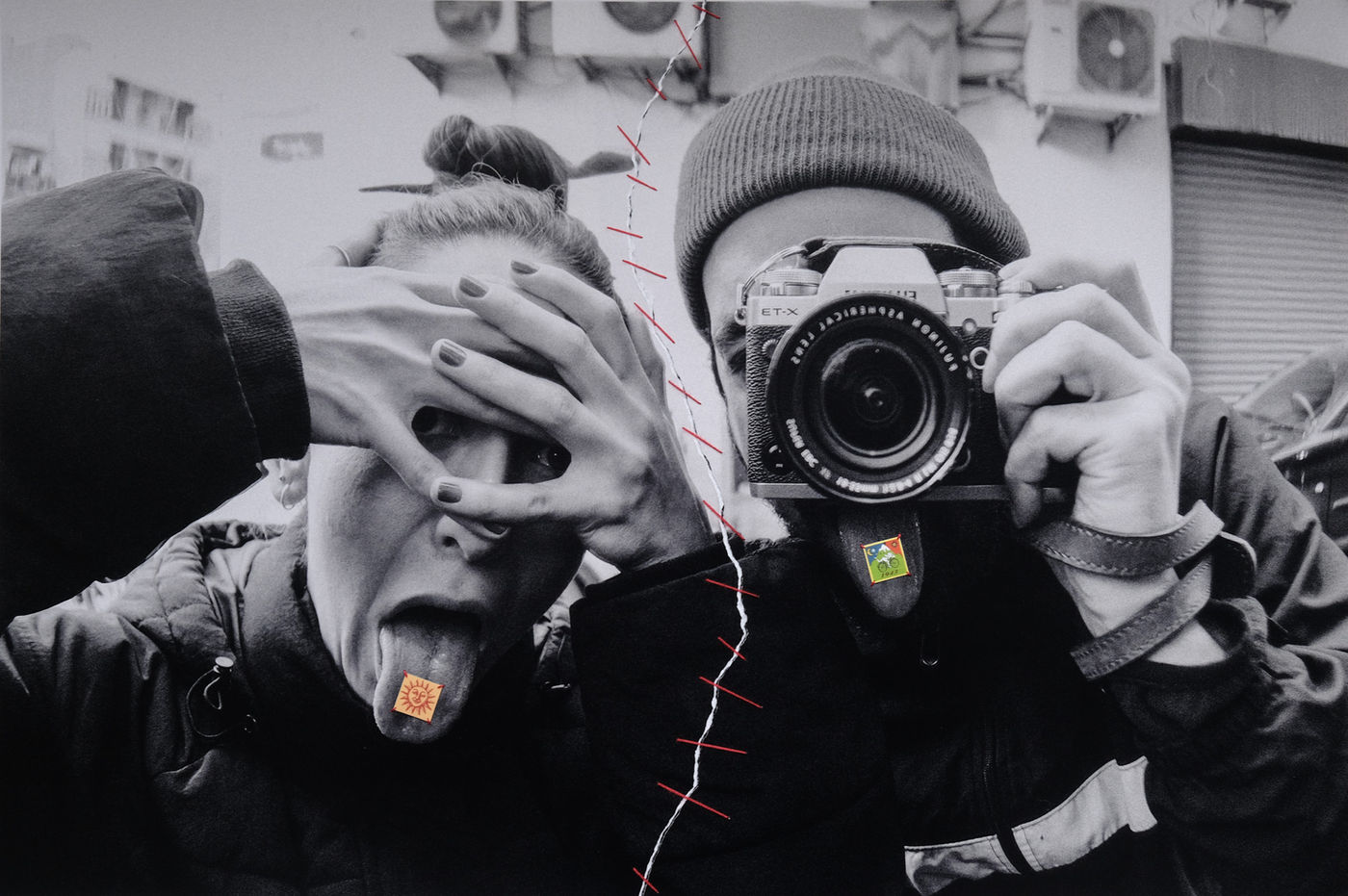
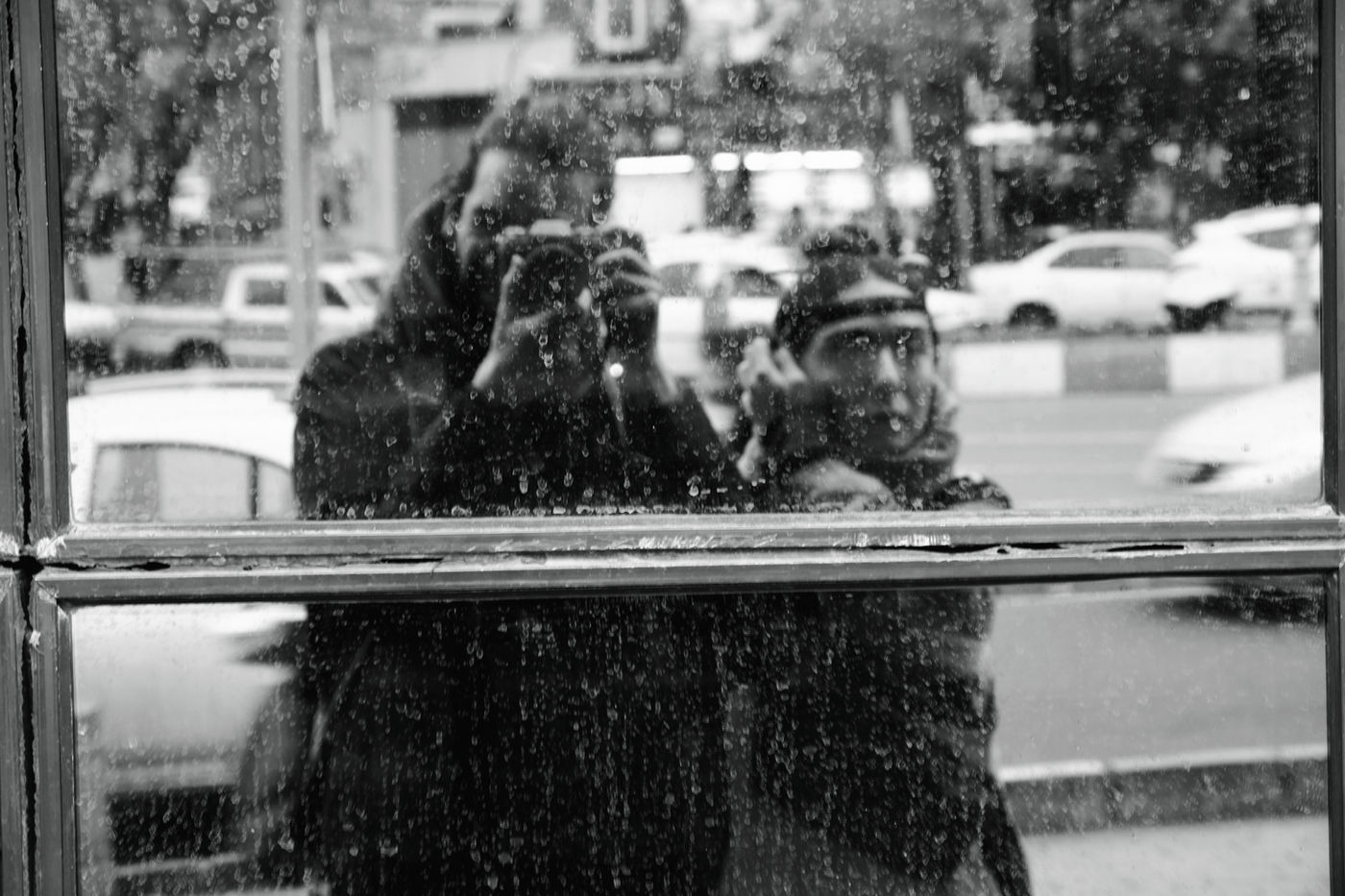
This is a self-portrait of the artists within the project. Here, we photograph each other—not as observers standing outside the city, but as two people already caught inside it. Tehran acts like a hallucinogen. It does not simply surround you; it enters quietly, without permission, and begins to change you. Its noise, contradictions, violence, beauty, and endless movement slowly alter the way you see, remember, and even recognize yourself. For years, we entered the city with a camera, believing that we were the ones looking. We photographed its streets, its people, its wounds, its gestures. But somewhere along the way, the direction of the gaze reversed. The city began photographing us back. Double Trip Tehran is the closest moment in the series when the project turns its gaze upon itself: two people who entered Tehran to document it, only to discover that they were also becoming part of what they were trying to understand. The embroidered image makes this transformation physical. The thread does not simply mark the photograph; it disturbs it, enters its surface, and creates another layer of perception. The photograph becomes both document and evidence of its own transformation. Perhaps this is what happens when you spend too long looking at a city. At some point, you can no longer tell where the city ends and where you begin.
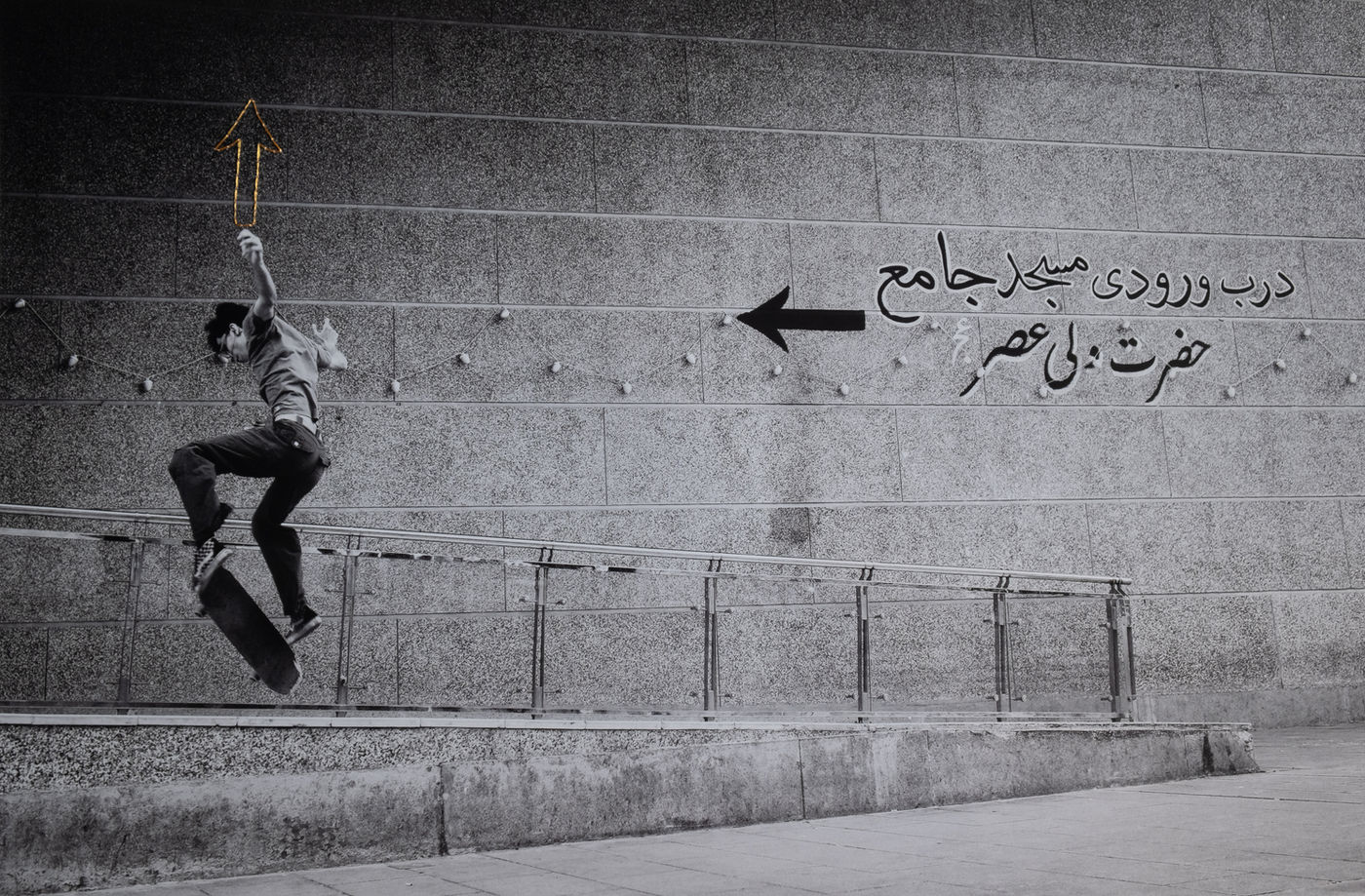
A young skateboarder rises into the air in front of the entrance sign of a mosque. For a brief moment, his body occupies the space between two systems of meaning: the written rules attached to the architecture behind him, and the unwritten rules he has chosen for himself. The image captures something that has become increasingly visible in Tehran’s public space: a generation negotiating its relationship with authority not necessarily through direct confrontation, but through movement, gesture, play, and the simple act of occupying space differently. The mosque stands as a structure of permanence. Its words are fixed, written, and meant to instruct. The skateboarder, by contrast, is temporary and unpredictable. He refuses the stillness expected of him. He takes a space designed to communicate obedience and turns it, for an instant, into a space of possibility. Extra Flash carries a double meaning. It is the sudden burst of light, the extra flash that interrupts the ordinary image. But it is also the spark of a generation that increasingly chooses movement over obedience, improvisation over instruction, and self-made rules over inherited ones. There is no clear revolution in this gesture. There is only a body in motion. Perhaps this is how social change first becomes visible: not in monuments or declarations, but in small acts of rearranging the space around us. A jump, a turn, a moment suspended in the air—and a generation quietly asking whether the rules written on the walls must also be written into their bodies.
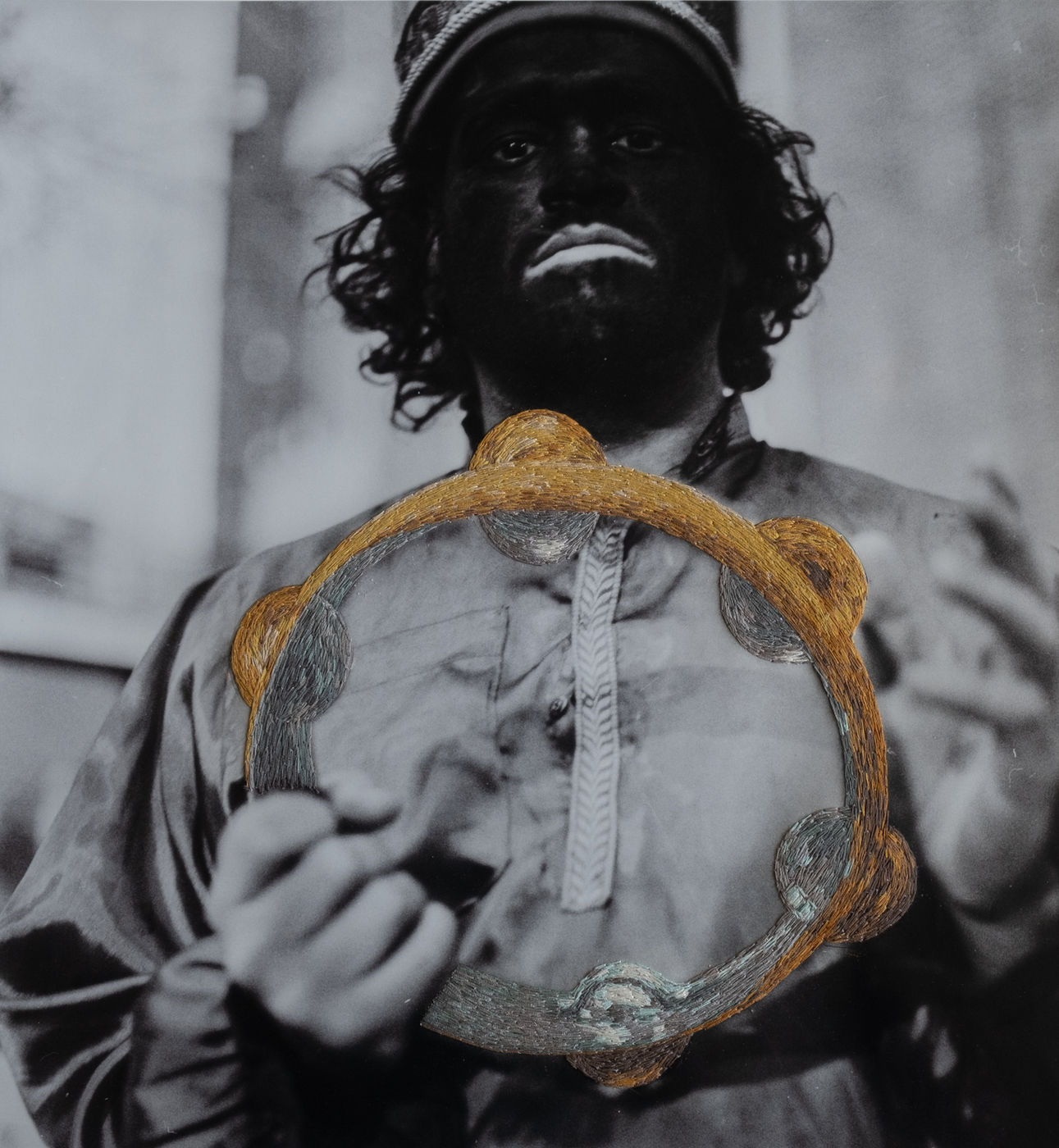
Four minutes before Nowruz—the Iranian New Year—I took this photograph. In the days leading up to Nowruz, Haji Firuz appears in the streets of Iran as one of the most recognizable figures of the approaching celebration. Dressed in vivid colors, he sings, dances, and plays his tambourine, announcing the arrival of a new year and bringing a moment of joy to those passing by. His presence belongs to the restless days before the calendar turns, when the old year is being left behind and everyone seems to be waiting for a beginning. But this photograph was taken at the very end of that performance. I had spent the entire day photographing. Only one frame remained on my 120 film. It was already dark when I encountered this man. After a long, exhausting day of performing in the streets, he looked completely spent. He insisted that I photograph him. “Man-e dorbin-i, take a picture of me. Let everyone know how tired I am.” So I did. There is something quietly devastating about the timing of this image. Four minutes later, a new year would begin. Around him, people were preparing to celebrate renewal, while his body carried the weight of the year that had just passed. The title, Long Tomorrow, belongs to that contradiction. Tomorrow is supposed to be new. But for some bodies, tomorrow arrives carrying yesterday with it. The last frame of the roll became a portrait of exhaustion at the precise moment when everyone else was waiting for a beginning.
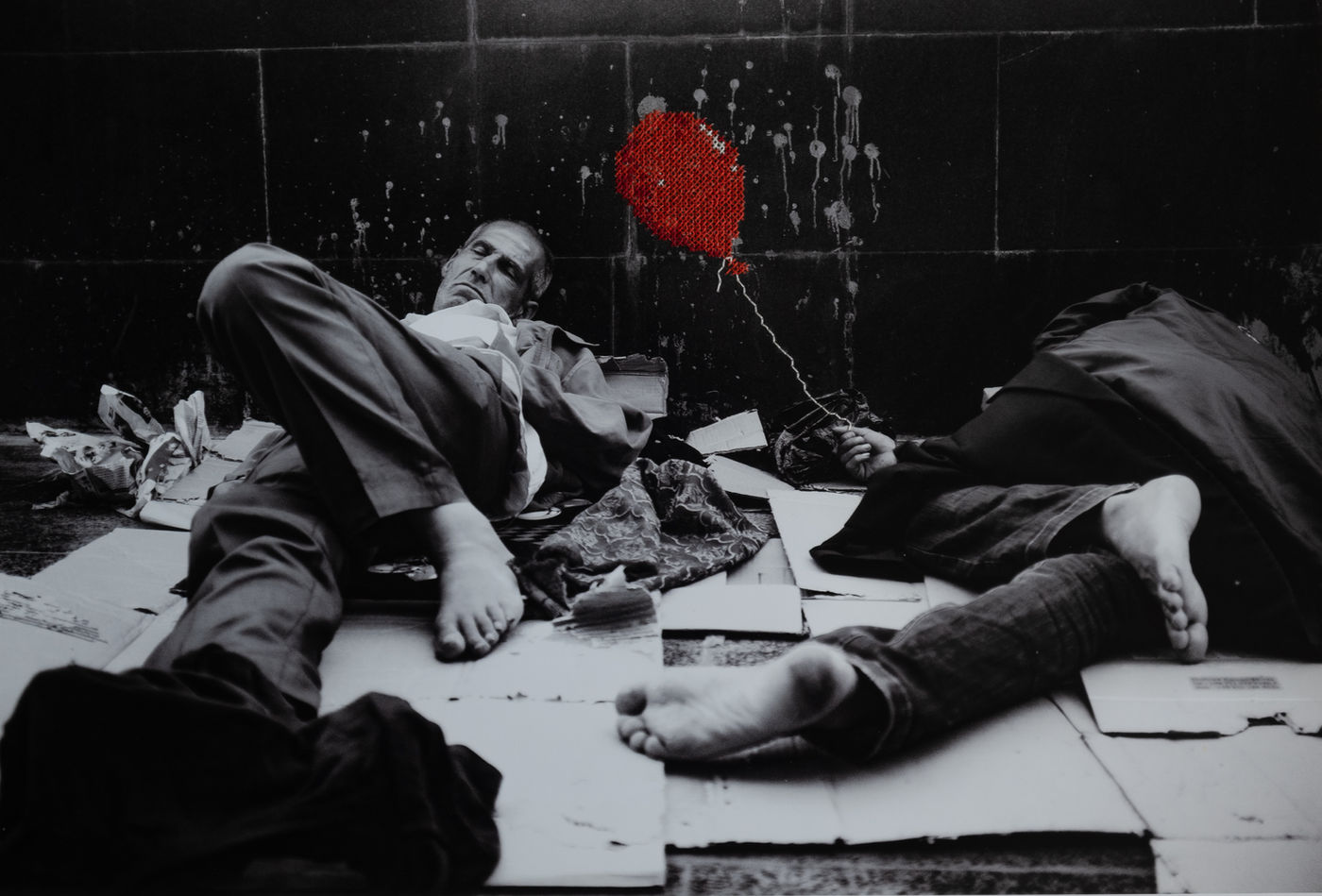
Two people have fallen asleep among the scattered remains of an ordinary life. Nothing in the scene suggests comfort. The objects around them are displaced, abandoned, without order. And yet, above this unsettled landscape, a balloon floats—light, delicate, almost impossibly beautiful. This is a dream that does not intend to wake. It remains suspended in a shallow, restless sleep, somewhere just before consciousness. A place where dreams begin to take shape, where desire becomes visible for a moment, but never quite becomes reality. Perhaps this is what makes the dream so unsettling. It does not take us somewhere entirely different. It appears inside the world we already inhabit, quietly changing its proportions. The familiar becomes strange; the ordinary begins to carry another meaning. The photograph remains faithful to reality, yet something within it has slipped away from reality. The balloon seems to belong to another world. It is almost too beautiful for the frame that contains it. A small promise of escape floating above a landscape that offers none. But it does not rise far enough. It remains caught within the image, just as the sleepers remain caught within their dream. Red Dream is not about the moment of waking. It is about the refusal to wake—to remain indefinitely in that fragile interval where possibility still exists, where the future can still be imagined, but never arrives. A beautiful dream. A difficult world. And two bodies suspended somewhere between the two.
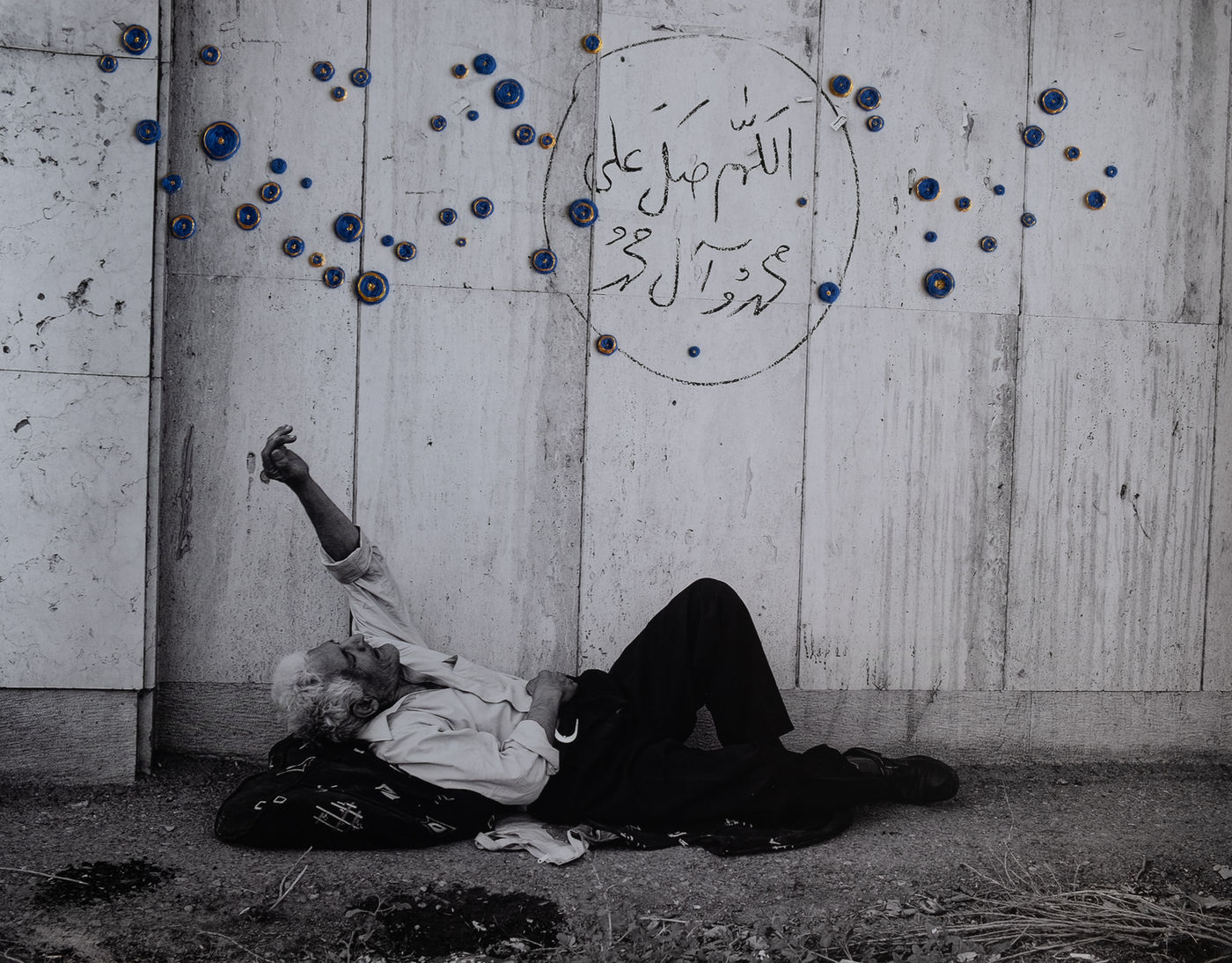
A man lies on the ground, his hand reaching upward. We don’t know what he wants. Maybe there is nothing there at all. But a hand reaching into emptiness is already a form of hope. The photograph tells us nothing about him. So we decided to give him no explanation. Instead, we embroidered 57 flowers onto the image. Not to beautify his suffering, but for one simple act: to be seen. The flowers are small. They cannot lift him. They cannot change anything. But they can remain. And remaining is its own form of resistance. In a city where people pass without looking, we stopped. We looked. We counted. One flower, two, three... until fifty-seven. Each flower is a pause, a breath, a witness. We don’t know his name. But anonymity should not mean invisibility. The embroidery does not speak for him. It simply stands beside him and says: I saw you. I did not walk past. Fifty-seven flowers cannot save anyone. But they can refuse the violence of looking away. For a man reaching toward something we cannot see — fifty-seven stitches saying the same thing: You are not invisible. Someone sees you.
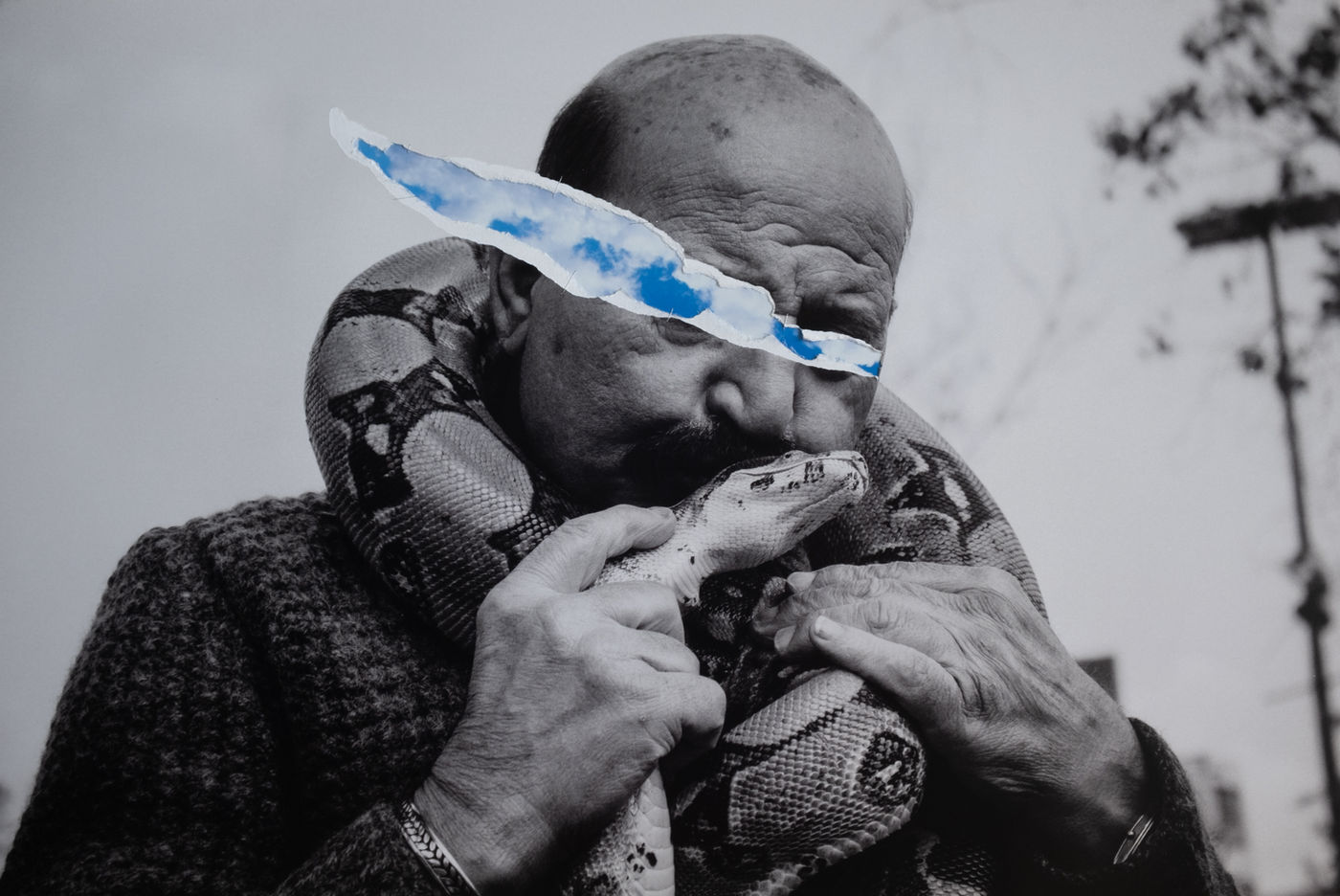
Before the city learned to entertain itself through screens, Tehran gathered around the human body. In the streets, squares, markets, and public passages, the marakeh-gir—the traditional street performer—would create a small theatre in the middle of everyday life. A circle of spectators would form around him. There might be a murshid, the master of the performance, and a bachche-murshid, his assistant: one commanding the centre, the other warming the crowd and preparing them for what was to come. The performances could take many forms: storytelling, tricks, feats of strength, snake handling, religious recitation, or acts designed to blur the boundary between the extraordinary and the possible. The audience was not separated from the performance by a stage. The street itself became the stage, and the crowd became part of the event. For generations, these temporary theatres belonged to the living memory of Tehran. They appeared, gathered a crowd, produced astonishment, received their coins, and disappeared again into the city. Seven Skies looks at this disappearing figure through another disappearing language. We embroidered only seven stitches. Seven knots. No more. The intervention is almost invisible, yet deliberate. Seven stitches become seven small interruptions in the photographic surface—seven points where the present touches something inherited, something that once belonged to the streets of Tehran. Seven is also the number of skies in an ancient Iranian and Islamic cosmology: layers separating the human world from what lies beyond it. But here, the stitches do not lead upward. They hold the image in place. Perhaps that is what remains of the marakeh-gir: not the spectacle itself, but the memory of a city that once gathered around a person, listened to a voice, and allowed a temporary circle of wonder to form in the middle of the street. Seven stitches for a disappearing theatre. Seven small knots between what Tehran was and what it is becoming. Seven skies—and a city still looking upward.
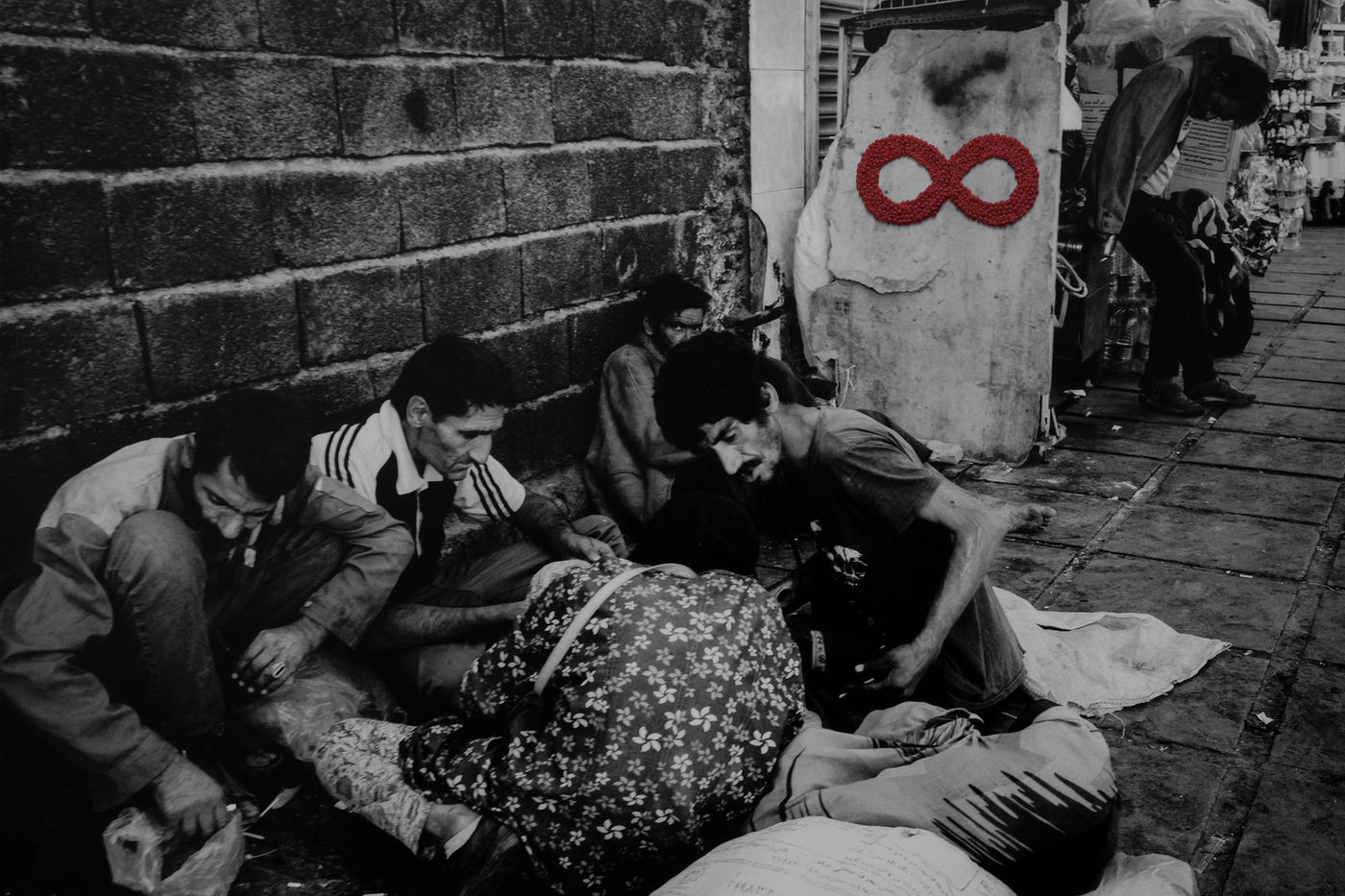
Addiction has no border. It does not belong to one city, one country, or one particular kind of person. It can enter any street, any family, any body. Tehran is not an exception. This photograph was made among a group of people struggling with addiction on the streets of Tehran. There is nothing exceptional about the scene. That is precisely what makes it difficult to look away. The title comes from The Wire, from Omar Little’s understanding of a world in which violence, survival, addiction, and poverty become part of a larger system—a game whose rules are inherited long before the players have chosen to enter it. It’s all in the game. But what happens when the game is no longer a metaphor? In this image, the men seem caught inside a system larger than themselves. Addiction appears not simply as an individual failure, but as a social condition: something shaped by poverty, exclusion, isolation, displacement, and the absence of meaningful alternatives. The man on the right carries the weight of the entire photograph upon his shoulders. His body becomes the place where everything else seems to settle—the men around him, the pavement beneath them, the city behind them, and the invisible structures that have brought them here. Above them, we have embroidered the symbol of infinity in red. It is not a symbol of eternity here. It is a symbol of repetition. One person. Then another. Then another. An infinite number of people entering the same circle, disappearing into the same cycle, returning to the same streets. The red thread introduces something almost violently alive into an otherwise monochromatic world. It becomes a wound, a warning, but also a count that cannot be completed. There is no final number for addiction. No final victim. No single city in which it ends. Tehran carries its own history of this struggle, just as every city does. And we could not speak about Tehran without speaking about the people who inhabit its margins—the people who remain visible in the streets, yet invisible within the stories a city tells about itself. The photograph asks us to look at the system surrounding them. Because perhaps the most frightening thing about infinity is not that it never ends. It is that we begin to recognize the pattern. And keep walking past it.
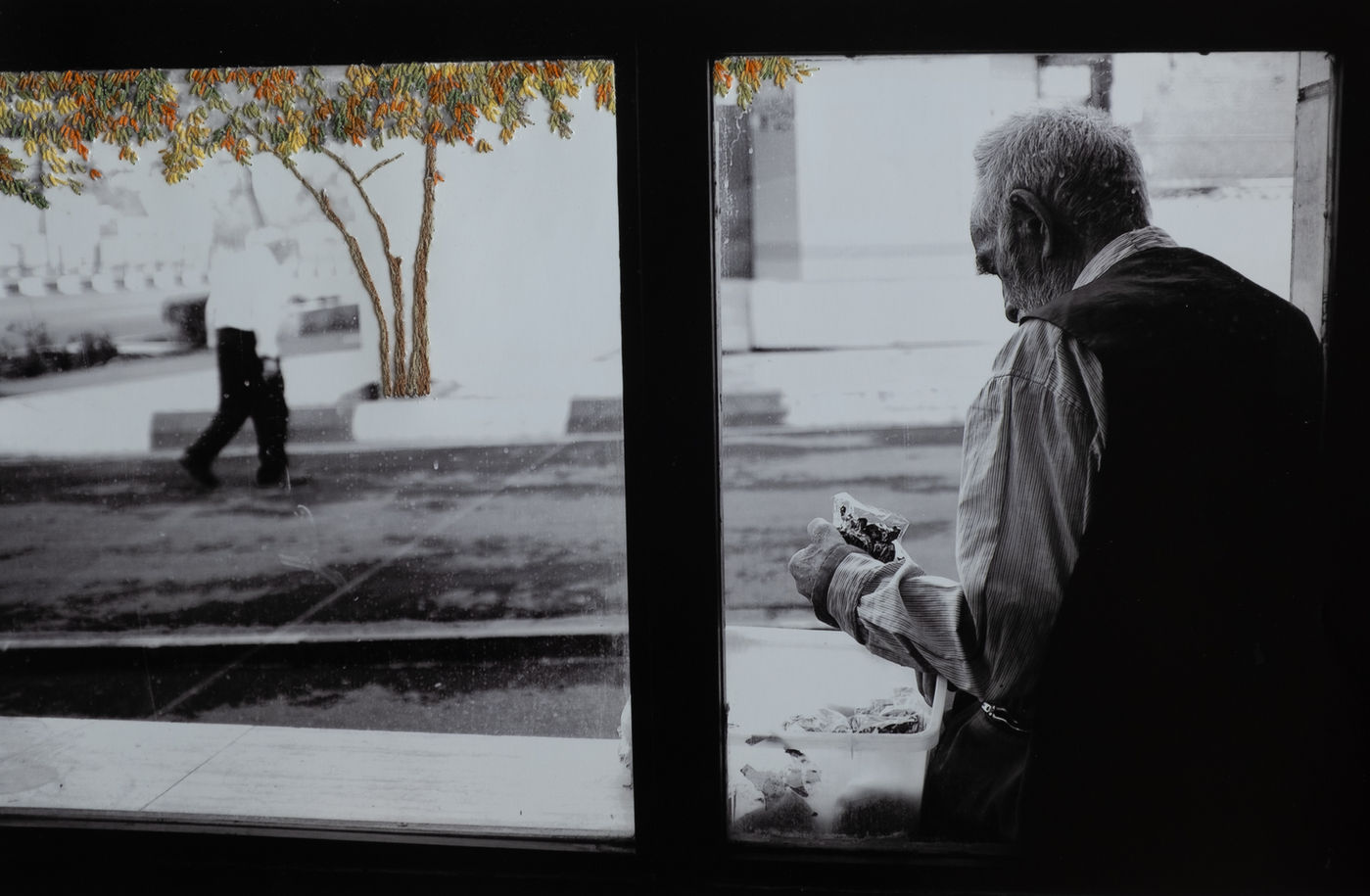
Two figures. One frame. Two solitudes. They stand together, yet nothing in the image suggests that they truly belong to one another. Their proximity does not erase the distance between them. Each seems enclosed within a private world, suspended for a moment in the restless landscape of Tehran. The title borrows its names from Samuel Beckett’s Waiting for Godot, where Vladimir and Estragon wait beside a lonely road for someone who never arrives. They talk, argue, remember, forget, and return to the same place. Time passes, but nothing changes. Their waiting becomes the action itself. Here, however, there is no Godot. Perhaps because in Tehran, waiting has already become a destination. Waiting for an answer. Waiting for change. Waiting for departure, for return, for a future that is always somewhere beyond the frame. The city produces a peculiar kind of suspension: life continues at full speed, while something essential remains perpetually postponed. In Beckett, the two men remain bound to the possibility that tomorrow might be different. In this photograph, that possibility feels more ambiguous. The two figures are not waiting for someone to arrive; they seem to be inhabiting the space between arrival and departure. The frame becomes a small stage. Tehran becomes the endless road. And these two figures, like Vladimir and Estragon, remain there—not because they have nowhere else to go, but because, after a certain point, waiting itself becomes a way of being. Two characters. One frame. And two people alone, together.
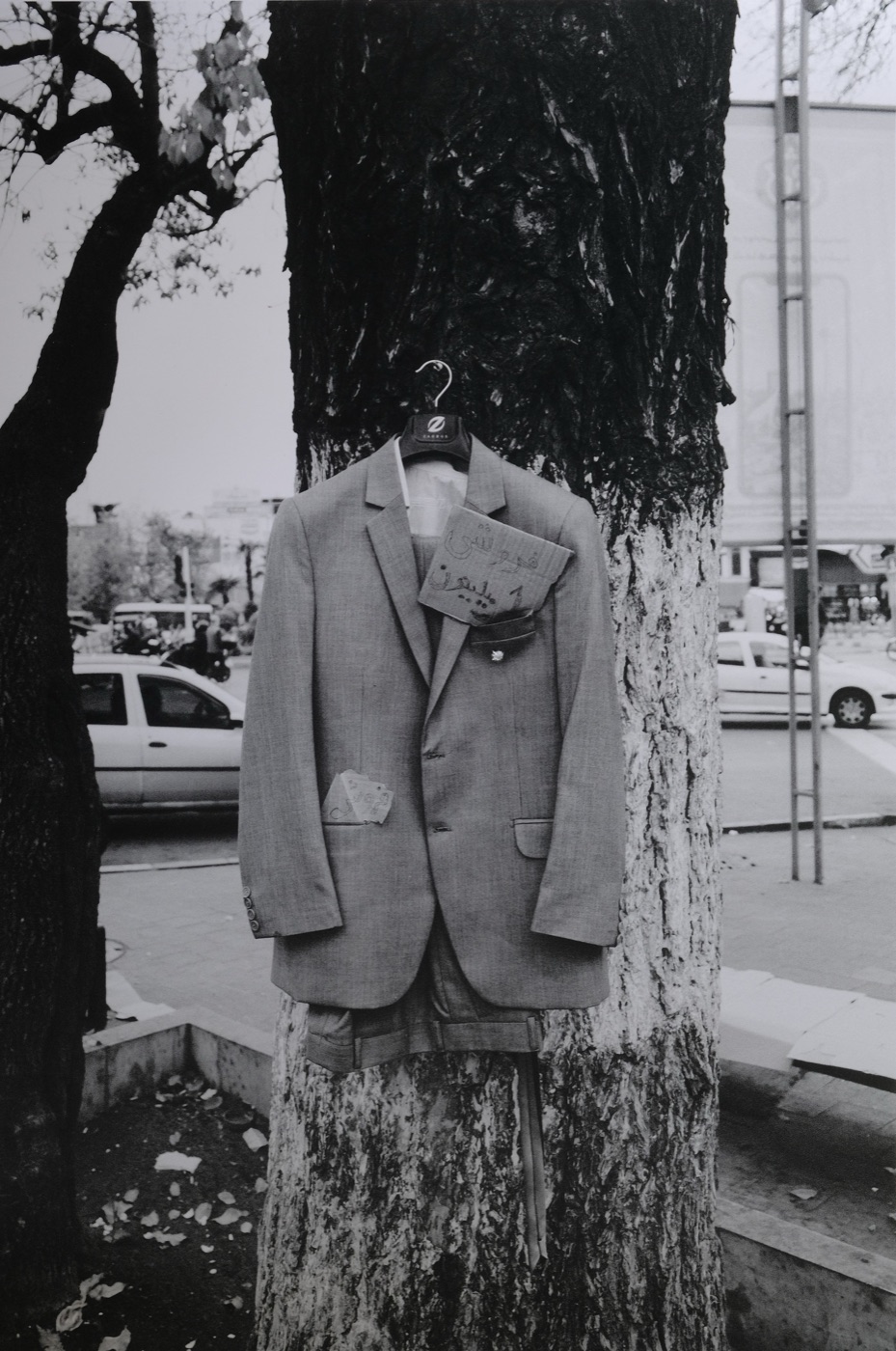
This is the only photograph in the series we could not embroider. Not because there was nothing left to stitch, but because there was too much. The wound was too severe. Any thread passing through this image felt like an attempt to repair something that could not—and perhaps should not—be repaired. So we left the photograph untouched. Almost. At the place where the heart of an absent man should have been, we pierced the image once. There is no body here. Only a coat.
A price is written on it: one million tomans. At the time of this work, roughly four dollars. A piece of clothing valued in money. A life reduced to an absence. The photograph holds an unsettling contradiction. The coat remains visible, carrying the shape of someone who is no longer there. The price remains legible, while the person has disappeared. What can be bought and measured survives; what cannot be priced is gone. The single puncture is therefore not an embroidery. It is a wound made to the image itself. It marks the place where a heart once belonged without attempting to reconstruct the person, explain the violence, or offer the comfort of repair. Perhaps this is why the photograph had to remain unstitched. Throughout 12,497 Knots, we intervene in photographs with thread. We cross their surfaces, cover their wounds, interrupt their memories, and sometimes try to give form to what cannot otherwise be seen. But here, intervention reaches its limit. There are wounds that resist decoration. There are absences that cannot be filled. And there are photographs that demand to remain open. Only one hole. Where the heart should be. Nothing else.
The image does not heal.
It remembers.